How to Decorate a Kitchen Step by Step
A kitchen can feel cluttered, dated, or short on personality, and figuring out where to start can be overwhelming. You’re not alone—many people struggle to bring their ideas together.
This step-by-step guide to how to decorate a kitchen will help you create a space that feels cohesive, welcoming, and uniquely yours.
To decorate your kitchen step by step, start by choosing a color palette you love, then pick a cohesive style theme to guide your decisions.
Next, select cabinet finishes, hardware, and countertops that fit your vision.
Layer in lighting, add soft textiles, and style your counters with decor.
Finally, organize your storage and finish with plants and personal touches.
Keep going and you’ll uncover exactly how each step comes together.
Key Takeaways
- Establish a color palette and cohesive style theme to guide all kitchen design decisions.
- Select cabinet finishes, hardware, and countertops that align with your chosen style and durability needs.
- Layer ambient, task, and accent lighting to enhance both function and mood.
- Decorate walls and counters with art, shelving, and textiles that reinforce your theme.
- Organize storage with bins, dividers, and labels to keep the kitchen functional and tidy.
Start With a Kitchen Color Palette You Love

Before you pick a single cabinet or countertop, nail down the colors that’ll anchor your kitchen’s look. Grab paint chips, fabric swatches, and photos of kitchens you admire, then look for patterns. Do you gravitate toward warm terracottas, cool blues, or crisp neutrals? That instinct matters more than trends.
Think about color harmony next. Pick one dominant hue, one supporting tone, and an accent color to tie everything together without creating visual chaos. Three colors are usually enough; more than that, and the space feels busy.
Consider mood setting too. Soft sage and creamy white create a calm, airy feel, while deep navy and brass pull toward something bold and dramatic. Ask yourself how you want to feel cooking breakfast or hosting friends.
Once you’ve settled on a palette, test it. Paint swatches directly on your walls and view them morning, afternoon, and night before committing.
Choose a Cohesive Style Theme for Your Kitchen

Once you’ve chosen your colors, think about the overall style you want for your kitchen. Maybe you’re drawn to farmhouse, modern, industrial, or coastal design. Let that style guide your choices, from the colors you’ve picked to the textures and shapes you bring in. Then tie everything together with hardware, textiles, and accessories that carry the look throughout the room.
Identify Your Design Style
Because every great kitchen tells a story, you’ll want to decide what yours should say before you pick up a single paint swatch. Your style sets the tone for every decision that follows, from cabinet color to hardware finish.
Think about how you want the space to feel. Do you crave farmhouse charm, with its worn wood and welcoming warmth? Or does modern minimalism speak to you, with clean lines and clutter-free counters?
| Style | Key Traits |
|---|---|
| Farmhouse Charm | Rustic wood, open shelving, warm tones |
| Modern Minimalism | Sleek surfaces, neutral palette, hidden storage |
| Coastal | Light colors, natural textures, airy feel |
| Industrial | Metal accents, exposed elements, bold contrast |
Pick the style that matches your lifestyle, not just a trend.
Select a Color Palette
Once you’ve settled on a style, let the colors bring it to life. A kitchen’s palette sets its mood, so aim for color harmony between your walls, cabinets, and countertops. Pick one dominant shade, then layer in accent colors through smaller details for depth and personality.
- Soft sage cabinets paired with brushed brass hardware for an earthy, modern feel.
- Crisp white walls that let natural light bounce and brighten the space.
- Charcoal countertops adding contrast and grounding the lighter tones.
- Terracotta accent tiles along the backsplash for warmth and texture.
Test samples in natural light before committing. Shades shift throughout the day. A well-balanced palette turns your kitchen into a space that feels intentional, inviting, and *distinctively* yours.
Coordinate Decor Elements
Before you buy a single accessory, decide on the story your kitchen should tell. Once you’ve chosen your color palette, pick a style theme—farmhouse, modern, coastal, or industrial—and let it guide every decision. This keeps decorative accents feeling intentional rather than random.
Match materials to your theme: wood and woven textures for farmhouse, sleek metals for modern, glass and blues for coastal. Color coordination matters here—your dish towels, rugs, and wall art should echo tones from your base palette, not fight against them.
Choose a few focal pieces, like a statement light fixture or patterned backsplash, and build smaller accents around them. Avoid mixing too many competing styles; instead, repeat shapes, finishes, or colors throughout the space so everything feels like it belongs together.
Choose Kitchen Cabinet Finishes and Hardware
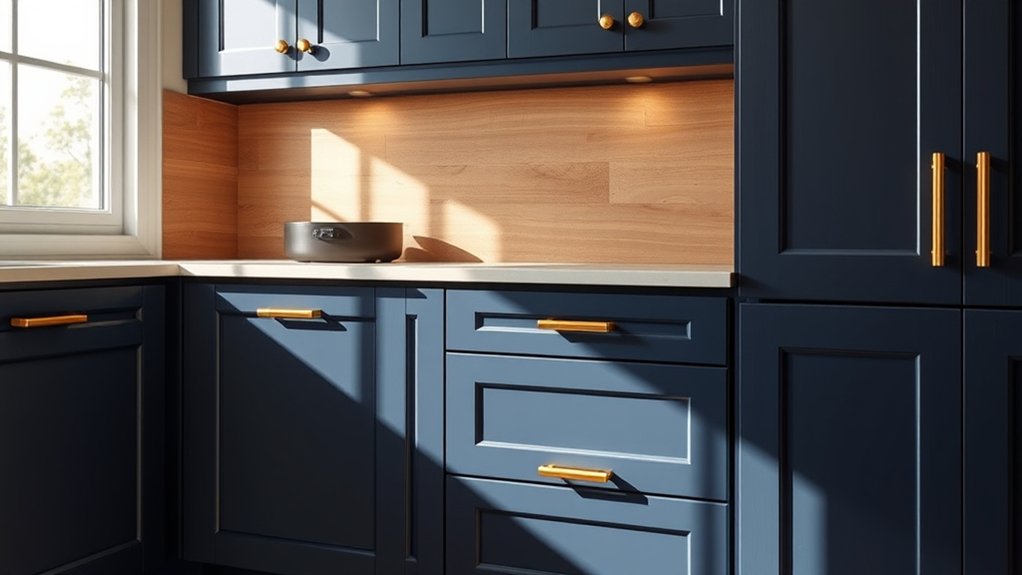
Since cabinets anchor your kitchen’s overall look, you’ll want to choose finishes and hardware that balance style with everyday durability. Start by picking a cabinet paint that suits your design vision, whether that’s a timeless white, a moody navy, or a warm wood stain. Then, select hardware styles that complement the finish without overwhelming it.
Picture these four options as you plan:
- Matte white cabinets paired with brushed brass pulls for a soft, modern glow.
- Deep forest-green paint with black iron knobs for bold contrast.
- Natural wood tones accented by sleek chrome handles for an understated shine.
- Classic navy cabinetry finished with polished nickel hardware for timeless elegance.
Test samples under your kitchen’s lighting before committing. Small swatches can look different once applied to full cabinet doors, so always check how colors and finishes read in natural and artificial light.
Select Kitchen Countertops for Beauty and Durability
Once your cabinets are in place, countertops are the next big design choice. Compare options like granite, quartz, butcher block, and laminate to find what works best for your lifestyle. Then choose a color and finish that complement your cabinets and overall kitchen style. As you weigh your options, consider both the upfront cost and the upkeep—some surfaces need more sealing and care than others.
Compare Countertop Material Options
How do you choose a countertop that won’t let you down? Start by weighing durability, maintenance, and style against your budget and lifestyle. Each material tells its own story in your kitchen.
- Quartz versus granite: Quartz offers consistent patterns and zero sealing, while granite brings natural veining and unmatched character to every slab.
- Marble alternatives: Quartzite and soapstone deliver that luxe marble look without the staining worries.
- Butcher block: Warm, workable wood that ages beautifully with proper oiling.
- Concrete: Industrial-chic surfaces you can customize with color and texture.
Think about how you cook, how you clean, and how much upkeep you’re willing to handle. The right match balances function with the aesthetic you’re after.
Match Style and Color
Before you fall in love with a slab, think about how its color and pattern will play off your cabinets, backsplash, and flooring. Color coordination keeps your kitchen from feeling disjointed. Pull a hue from your backsplash tile or cabinet finish to tie everything together. Style matching matters just as much: a sleek quartz slab suits modern cabinetry, while honed marble complements farmhouse or traditional designs.
Use this quick guide to pair countertops with your kitchen’s look:
| Kitchen Style | Countertop Match |
|---|---|
| Modern | Quartz, polished granite |
| Farmhouse | Butcher block, honed marble |
| Traditional | Granite with warm veining |
| Industrial | Concrete, soapstone |
Choose finishes that echo your existing palette, and your countertops will feel like they’ve always belonged.
Weigh Cost and Maintenance
Finding a countertop that matches your style is only half the equation. You’ll also want to think about what it costs to buy, install, and maintain over time. Run a cost comparison before committing, since prices vary dramatically by material. Then factor in upkeep, because some surfaces demand more attention than others.
- Granite: Gorgeous natural veining, but it needs periodic sealing to resist stains.
- Quartz: Nonporous and low-maintenance, offering durability without constant care.
- Butcher Block: Warm and inviting, though it scratches easily and requires regular oiling.
- Laminate: Budget-friendly and simple to clean, but less resistant to heat and scratches.
Follow basic maintenance tips—wipe spills quickly, use cutting boards, and avoid harsh chemicals—to keep any countertop looking its best for years.
Layer In Kitchen Lighting for the Right Mood
Since no single fixture can handle cooking, cleaning, and entertaining uniformly well, you’ll want to layer three types of light into your kitchen: ambient, task, and accent. Start with ambient lighting—ceiling fixtures or recessed lights that fill the room with overall brightness.
Add task lighting under cabinets and above counters so you can chop, read recipes, and cook without squinting. Finally, bring in accent lighting, like pendant lights over an island or LED strips inside glass cabinets, to add depth and personality.
This layered lighting approach gives you flexibility: bright and functional during meal prep, softer and warmer for dinner parties. Install dimmers on your switches so you can adjust intensity instantly, shifting from practical task light to relaxed mood lighting in seconds.
Mix warm and cool bulbs strategically, keeping warmer tones near seating areas and cooler light near workspaces. The right lighting plan transforms your kitchen’s function and feel throughout the day.
Style Kitchen Walls With Art and Shelving
Blank kitchen walls are a missed opportunity. Add personality above your counters or cabinets with a bold piece of art or a row of open shelves. Either option can turn a plain wall into a focal point.
For a look that feels curated rather than cluttered, balance visual interest with function. Mix textures and frames, and leave enough breathing room between pieces.
Choose Statement Wall Art
Why settle for bare walls when a bold piece of art can anchor your kitchen’s entire look? Statement art turns an empty space into a focal point that reflects your style. Choose a piece that complements your color scheme while adding contrast and depth.
- A large abstract canvas bursting with warm oranges and deep blues above your counter
- A vintage botanical print framed in brass, hanging near your dining nook
- A black-and-white photography series lined up above open shelving
- A quirky typography sign spelling out a favorite recipe or phrase
Hang your statement art at eye level, and let it draw attention the moment someone walks in. It’s the detail that makes your kitchen unforgettable.
Install Open Shelving
Once you’ve hung your statement art, open shelving gives your kitchen walls a second layer of style and function. Choose sturdy wood or metal brackets that match your existing hardware finishes, then mount shelves at staggered heights for visual interest.
Open shelving works best when you style it with intention. Mix everyday dishware with decorative accessories like small plants, ceramic bowls, or framed prints to create a curated look. Keep groupings in odd numbers and vary heights and textures to avoid a flat appearance.
Leave breathing room between items so the display doesn’t feel cluttered. Position shelves near your statement art to tie the wall together, letting both elements complement rather than compete. This combination adds warmth, practicality, and a personalized touch to your kitchen’s overall design.
Mix Textures and Frames
After you’ve arranged your shelves and art, mix frame materials and textures to keep your kitchen walls from feeling one-note. Textural contrast adds depth, so pair smooth surfaces with rougher ones in addition to matching everything exactly. Smart frame pairing lets pieces complement each other without looking like a matched set.
- Hang a black metal frame beside a weathered wood one for warmth and edge.
- Lean a woven basket near framed prints to introduce natural fiber.
- Add a ceramic plate or ceramic vase to break up flat, glossy frames.
- Mix matte and glossy finishes across shelf objects to catch light differently.
Keep one material consistent, like black hardware, to tie varied textures along with without looking disjointed or cluttered.
Add Rugs, Curtains, and Soft Kitchen Textiles
Textiles bring warmth and personality to a kitchen that hard surfaces can’t achieve alone. Start with rug placement in front of the sink, stove, or prep area where you stand most. A washable, low-pile rug handles spills without trapping grime, and it cushions your feet during long cooking sessions. Choose a pattern that complements your cabinetry without competing with your backsplash.
Next, consider curtain styles for windows above the sink or near the dining nook. Café curtains offer privacy while letting light filter through, and roman shades give a cleaner, more tailored look if you prefer minimal fuss. Pick fabrics that resist moisture and grease buildup, since kitchens generate both.
Don’t forget smaller textiles like dish towels, oven mitts, and table runners. These pieces let you experiment with color and texture without committing to a major design change, and you can swap them seasonally to refresh the space instantly.
Style Your Kitchen Counters With Decor
Since your soft textiles are in place, your counters are the next canvas for pulling the room’s look together. Choose decorative accessories that balance beauty and purpose, so your kitchen feels styled, not cluttered. Group items in odd numbers and vary their heights to create visual interest.
Keep countertop maintenance in mind as you decorate. Select pieces that are easy to wipe down and move when you’re cooking or cleaning.
Choose decor that’s easy to wipe clean and quick to shuffle aside when cooking takes over the counters.
Try these ideas:
- A wooden cutting board leaned against the backsplash, paired with a small potted herb plant.
- A ceramic bowl filled with fresh lemons or seasonal fruit.
- A short stack of cookbooks topped with a small vase of flowers.
- A sleek oil and vinegar set displayed on a small tray.
Keep your counters mostly clear near work zones. Functional decor, like a stylish utensil holder, adds charm without sacrificing practicality.
Organize Kitchen Storage to Beat Clutter
Once your counters look the part, it’s time to tackle what’s hiding behind your cabinet doors. Clutter breeds in corners you don’t see every day, so start with pantry organization. Pull everything out, group items by category, and use clear bins or labeled baskets so you can spot what you need at a glance. Decant dry goods into matching containers to free up shelf space and keep pests out.
Next, tackle utensil storage. Ditch the overflowing drawer and sort tools by function: cooking, baking, and serving. Use dividers or small caddies to keep them upright and accessible. Hang frequently used items on a wall rail if drawer space runs tight.
Finally, assign a home for everything, from spices to small appliances. Store heavier items low and rarely used pieces up high. A well-organized kitchen doesn’t just look better. It makes cooking faster and far less frustrating.
Add Plants and Personal Touches to Your Kitchen
After your storage’s squared away, let your kitchen show a little personality. Indoor greenery breathes life into the space, while personal mementos turn a functional room into one that feels like yours. You don’t need a green thumb or a houseful of trinkets. Just a few thoughtful touches do the trick.
- Herb pots on the windowsill – Basil, mint, and thyme add color and scent you can actually use.
- A trailing pothos on top of the fridge – Its vines soften hard edges and add movement.
- Framed postcards from trips you’ve taken – Small reminders of places you love.
- A shelf of mismatched mugs from family – Each one tells a story.
Mix these elements with your existing decor instead of overcrowding counters. Let plants breathe, and give mementos room to stand out. Small additions like these make your kitchen feel warm, lived-in, and unmistakably yours.
Frequently Asked Questions
How Much Does It Typically Cost to Decorate a Kitchen?
You’ll typically spend anywhere from $500 to $5,000, depending on your choices. Cost estimation starts with deciding whether you’re updating décor or doing a full overhaul. If you’re just adding accessories, paint, and small fixtures, you’ll stay on the lower end.
For bigger upgrades, you’ll need solid budget planning. Factor in materials, labor, and unexpected expenses. Set a realistic range upfront, and you won’t overspend once you start transforming your space!
How Long Does a Full Kitchen Decorating Project Usually Take?
You’re racing against the clock, but you’ll usually wrap up a full kitchen decorating project in two to four weeks. You’ll spend the first week nailing down color coordination, picking palettes that tie your cabinets, walls, and accessories together. Next, you’ll tackle lighting improvements, swapping fixtures and adding accent lights to set the mood. Finally, you’ll add finishing touches like décor and textiles, transforming your kitchen into a space you’ll love.
Can I Decorate My Kitchen Without Renovating It?
Yes, you absolutely can! You don’t need a renovation to transform your kitchen’s look. Start by adding personalized accessories like statement bowls, artwork, or unique dish towels that reflect your style.
Next, focus on lighting improvements. Swap outdated fixtures for pendant lights or add under-cabinet lighting to brighten your space instantly. You’ll be amazed how these simple, budget-friendly changes create a fresh, updated feel without the mess, cost, or time commitment of a full renovation.
What Kitchen Decorating Mistakes Should Beginners Avoid?
Avoid ignoring color coordination—clashing hues can make your kitchen feel chaotic instead of cohesive. Stick to a simple palette with two or three complementary colors. Don’t skip clutter management, either; overcrowded counters and open shelves quickly overwhelm a space. You’ll want to clear away unnecessary items and find smart storage solutions. Also, avoid rushing your choices—take time to test colors and arrangements before committing, since hasty decisions often lead to costly redos later.
How Often Should I Update My Kitchen’s Decor?
You don’t need to overhaul your kitchen every year—aim for small updates every 2-3 years. Swap out accessories, textiles, or hardware to keep things fresh without a full renovation.
Pay attention to decorating trends, but don’t chase every one; choose elements that’ll age well. If you’re craving a bigger change, refresh your color schemes with new paint or backsplash accents every 5-7 years for a timeless, updated look.
Conclusion
From chaotic countertops to a serene, styled space, you’ve got the power to transform it all. You’ve chosen colors that speak to you, textures that invite touch, and lighting that shifts from bright and busy to soft and intimate.
Where clutter once lived, order now reigns. Where blank walls stood, your personality shines through. Take these steps one at a time, and you’ll learn how to decorate a kitchen and turn a purely functional room into the heart of your home.